 |
«APPROVED» Vice-Rector for Academic Affairs I. G. Mamajonov ________________________ «____»________________ 2025 year |
syllabus for the course
Microbiology, virology, immunology
1. General Information
2. Course Objective
The purpose of this course is To acquire knowledge about the structure of microorganisms, understand their distribution, learn to diagnose diseases caused by microorganisms, apply microbiological diagnostic methods in practice, identify bacteria, distinguish between specific and non-specific factors of immunity, understand structural differences of viruses and diagnose the diseases they cause, as well as gain knowledge about the treatment and prevention of infectious diseases.
3. Prerequisites for the Course
1. Medical Biology and General Genetics (TBUG1106)
2. Histology, Cytology, Embryology (GS12308)
4. Learning Outcomes
4.1. Knowledge Aspect:
- Have an understanding of the main types of microorganisms, modern medical microbiology, virology and immunology as a discipline, its goals and objectives; pathogenic bacteria, rickettsiae, mycoplasmas, viruses, protozoa, and microscopic fungi - their taxonomic classification, morphological and biological characteristics;
- Understand the distribution of microorganisms in the external environment, the influence of environmental factors on microorganisms, the genetics of microorganisms and the variability occurring within them and its significance; the pathogenicity, virulence, and pathogenic factors of pathogenic microorganisms, as well as their role in the development of infectious processes;
- Know the main defense mechanisms of the body—specific and non-specific—and their practical importance; the microbiological and molecular-biological basis of chemotherapy and chemoprophylaxis; differential characteristics of human infectious disease agents, laboratory diagnostics, specific prevention and therapy, as well as the importance of sanitary-indicative microorganisms in the environment and food;
- Apply bacteriological, virological, serological, biological, and allergological methods for diagnosing infectious diseases and for assessing environmental conditions in medical and sanitary-hygienic practice;
- Anticipate the likelihood of infectious diseases, design diagnostic strategies, select diagnostic methods, and master scientific methods of microbiological research; perform bacteriological, serological, virological, and sanitary-microbiological laboratory work, provide theoretical justification for these methods, and carry out sanitary-microbiological assessments of environmental objects (soil, water, air, housing, and food products);
- Possess skills in the classification of infectious disease pathogens and in determining their tinctorial, cultural, biochemical, and antigenic properties; establish bacteriological, virological, and serological diagnoses of diseases based on their etiology, source, transmission routes, clinical course, treatment, and prevention methods;
4.2. Skills Aspect:
- Knowledge of the structure of microorganisms;
- Practical skills in performing microscopic methods;
- Knowledge of the distribution of microorganisms;
- Knowledge of diagnosing diseases caused by microorganisms;
- Practical application of microbiological diagnostic methods;
- Identification of bacteria;
- Knowledge of the origin of infectious processes;
- Distinguishing specific and nonspecific factors of immunity;
- Mastering the functions of the humoral and cellular immune systems;
- Knowledge of the differences in the structure of viruses and knowledge of diagnosing the diseases they cause;
- Knowledge of measures for the treatment and prevention of infectious diseases.
5. Course Content
5.1. Lecture Content
5.2. Practical Session Content
No topic specified for Seminar or Seminar is not scheduled in this syllabus.
5.3. Laboratory Session Content
6. Independent Study Assignments
| № | Content of Assignments |
|---|---|
| 1. |
Types of herpesviruses, their distribution, and impact on human health |
| 2. |
Molecular basis of retroviruses and HIV infection |
| 3. |
Bacteriophages and their role in determining bacterial susceptibility |
| 4. |
Biological basis of innate and acquired immunity |
| 5. |
Mechanisms of vaccination and formation of immune memory |
| 6. |
Immunological basis of allergy and hypersensitivity reactions |
| 7. |
Systemic infections caused by fungi and their laboratory diagnosis |
| 8. |
Identification of bacteria and archaea through genomic analysis |
| 9. |
Immunotherapy and its role in modern medicine |
| 10. |
Immunodeficiency conditions and their clinical manifestations |
Preparation of presentations on the topic and completion of practical assignments.
7. References:
7.1. Main References
- Mukhamedov I.M., Aliyev Sh.R., et al. Microbiology, Virology, and Immunology / Textbook. Tashkent, 2019. 2019. –573 page.
- Zverev V.V. Medical Microbiology, Virology, and Immunology / Textbook. Moscow, 2021. –471 page.
- Gladwin M., Trattler W., Mahan C. Clinical Microbiology. Copyright 2014. –403 page.
7.2. Additional References
- Mukhamedov I.M., Aliyev Sh.R., et al. Microbiology, Virology, and Immunology / Textbook. Tashkent, 2006. –592 page.
- Aliyev Sh.R., Muhamedov I.M., et al. Laboratory Work in Microbiology, Virology, and Immunology. Educational-methodical manual. Tashkent, 2013. –127 page.
- Muhamedov I.M., et al. Clinical Microbiology: Guide for Physicians. Tashkent, 2016. –448 page.
- Nuruzova Z.A., Aliyev Sh.R., Yodgorova N.T., et al. Laboratory Work in Microbiology, Virology, and Immunology. Educational-methodical manual. Tashkent, 2019. –58 page.
- Muhamedov I., Eshboyev E., Zokirov N., Zokirov M. Microbiology, Immunology, Virology / Textbook. Tashkent, 2006. –510 page.
7.3. Information Sources
- https://learn.chm.msu.edu/vibl/content/antimicrobial.html
- http://www.rusmedserv.com/mycology/html/iomals.html
- http://www.ncbi.nlm.nih.gov/pubmed/
Head of Information Resource Center ______________ G. Kodirova
8. Course Assessment Criteria and Plan
8.1. Student Assessment Types
Для оценки знаний студентов по данному предмету используются следующие виды контроля: Current Assessment (CA), Midterm Exam (ME), Final Exam (FE).
Current Assessment (CA). This type of control is accumulated throughout the semester and consists of the following::
- Workshop. The studentʼs activity in the lessons and his answers to the questions asked are evaluated.;
- Preparation of presentations. Depending on the nature of the subject, the student, individually or in small groups, defends the assigned tasks in the form of a presentation / media / written / visual. Group members (teams) organize and fulfill the task assigned by the teacher. The total score assigned to the group is recorded as an individual score assigned to each member-student.;
- Tasks / assignments. Performs tasks related to practical training and laboratory exercises directly using equipment and reagents, prepares and defends assignments based on theory in the form of a report.;
- Attendance. The student is evaluated based on the percentage of participation in class sessions..
Midterm Exam (ME). Ushbu nazorat turi semestrning (10-haftasida) belgilangan kun davomida oʻtkaziladi. Fan oʻqituvchisi oraliq imtihon shakli va oʻtkazish tartibi toʻgʻrisida talabalarni fan semestrining dastlabki darslarida xabardor qiladi.
Final Exam (FE). Semestr yakunlangandan soʻng yakuniy imtixonlar haftasida Oral examination shaklda olinadi.
8.2. Student Assessment Criteria
| № | Control Types | Description | Score | Time of Conduct (start – end) |
|---|---|---|---|---|
| Current Assessment (CA) | ||||
| Kuzgi semestr | ||||
| 1 | Workshop | The studentʼs activity in the lessons and his answers to the questions asked are evaluated. | 5 | Weeks 2–13 Content |
| 2 | Preparation of presentations | Depending on the nature of the subject, the student, individually or in small groups, defends the assigned tasks in the form of a presentation / media / written / visual. Group members (teams) organize and fulfill the task assigned by the teacher. The total score assigned to the group is recorded as an individual score assigned to each member-student. | 10 | Weeks 4-14 Content |
| 3 | Tasks / assignments | Performs tasks related to practical training and laboratory exercises directly using equipment and reagents, prepares and defends assignments based on theory in the form of a report. | 10 | Weeks 4-13 Content |
| 4 | Attendance. | The student is evaluated based on the percentage of participation in class sessions. | 15 | Weeks 1-15 Content |
| Joriy baholash uchun maʼlumot qoʻshish | ||||
| Total | 40 | |||
| Midterm Exam (ME) | ||||
| 1. | Practical assignment | Oraliqqacha oʻtilgan mavzular yuzasidan tayyorlangan savollar bileti boʻyicha | 20 | 10-week |
| Total | 20 | |||
| Final Exam (FE) | ||||
| 1. | Oral examination | Oʻtilgan mavzular yuzasidan amaliy va nazariy savollar | 40 | After Completion of the Course |
| Total | 40 | |||
| Total | 100 | |||
8.3. Description of Assessment at Kokand University
| Grade | Percentage | GPA |
|---|---|---|
| A+ | 95-100 | 4.5 |
| A | 90-94 | 4.0 |
| B+ | 80-89 | 3.5 |
| B | 70-79 | 3.0 |
| C+ | 65-69 | 2.5 |
| C | 60-64 | 2.0 |
| F | 0-59 | 0 |
Izoh: Talaba 0-59 oraligʻida oʻzlashtirish koʻrsatkichiga yoki bir fanning 1/3 qismiga sababsiz qatnashmasa oʻqiyotgan semestrida mazkur fandan oʻzlashtirmagan (feyl), akademik qarzdor hisoblanadi. Oʻzlashtirilmagan fanlarni qayta oʻzlashtirish uchun talaba oʻrnatilgan tartibda fan oʻqituvchisi tomonidan berilgan topshiriqlarni bajarishi zarur.
Talabaning fan boʻyicha oʻzlashtirish koʻrsatkichini nazorat qilishda quyidagi mezonlar tavsiya etiladi:
a) aʼlo (A, A+) baho olish uchun talabaning bilim darajasi quyidagilarga javob berishi lozim:
- fanning moxiyati va mazmunini toʻliq yorita olsa;
- fandagi mavzularni bayon qilishda ilmiylik va mantiqiylik saqlanib, ilmiy xatolik va chalkashliklarga yoʻl qoʻymasa;
- fan boʻyicha mavzu materiallarining nazariy yoki amaliy ahamiyati haqida aniq tasavvurga ega boʻlsa;
- fan doirasida mustaqil erkin fikrlash qobiliyatini namoyon eta olsa;
- berilgan savollarga aniq va loʻnda javob bera olsa;
- konspektga puxta tayyorlangan boʻlsa;
- mustaqil topshiriqlarni toʻliq va aniq bajargan boʻlsa;
- fanga tegishli qonunlar va boshqa meʼyoriy-xuquqiy xujjatlarni toʻliq oʻzlashtirgan boʻlsa;
- fanga tegishli mavzulardan biri boʻyicha ilmiy maqola chop ettirgan boʻlsa;
- tarixiy jarayonlarni sharxlay bilsa;
b) yaxshi (B, B+) baho olish uchun talabaning bilim darajasi quyidagilarga javob berishi lozim:
- fanning moxiyati va mazmunini tushungan, fandagi mavzularni bayon qilishda ilmiy va mantiqiy chalkashliklarga yoʻl qoʻymasa;
- fanning mazmunini amaliy ahamiyatini tushungan boʻlsa;
- fan boʻyicha berilgan vazifa va topshiriqlarni oʻquv dasturi doirisida bajarsa;
- fan boʻyicha berilgan savollarga toʻgʻri javob bera olsa;
- fan boʻyicha konspektini puxta shakllantirgan boʻlsa;
- fan boʻyicha mustaqil topshiriqlarni toʻliq bajargan boʻlsa;
- fanga tegishli qonunlar va boshqa meʼyoriy xujjatlarni oʻzlashtirgan boʻlsa.
c) qoniqarli (C, С+) baho olish uchun talabaning bilim darajasi quyidagilarga javob berishi lozim:
- fan xaqida umumiy tushunchaga ega boʻlsa;
- fandagi mavzularni tor doirada yoritib, bayon qilishda ayrim chalkashliklarga yoʻl qoʻyilsa;
- bayon qilish ravon boʻlmasa;
- fan boʻyicha savollarga mujmal va chalkash javoblar olinsa;
- fan boʻyicha matn puxta shakllantirilmagan boʻlsa.
d) quyidagi hollarda talabaning bilim darajasi qoniqarsiz (F) baho bilan baholanishi mumkin:
- fan boʻyicha mashgʻulotlarga tayorgarlik koʻrilmagan boʻlsa;
- fan boʻyicha mashgʻulotlarga doir xech qanday tasavvurga ega boʻlmasa;
- fan boʻyicha matnlarni boshqalardan koʻchirib olganligi sezilib tursa;
- fan boʻyicha matnda jiddiy xato va chalkashliklarga yoʻl qoʻyilgan boʻlsa;
- fanga doir berilgan savollarga javob olinmasa;
- fanni bilmasa.
9. Exam Requirements and Instructions
|
1. Talaba imtihon nazorati qoidalarini buzgan hollarda, mazkur fandan imtihon bali bekor qilinishi haqida ogohlantiriladi. 2. Komissiya aʼzosi imtihon boshlanishini eʼlon qilgunga qadar imtihon varagʻini ochish taʼqiqlanadi. 3. Talaba uyali yoki boshqa aloqa vositalari, gadjetlarni oʻchirib, komissiya aʼzosi koʻrsatmasiga binoan oʻzidan uzoqlikda saqlashi shart. Kitob, manuskript, daftar va boshqa koʻmaklashuvchi materiallardan foydalanish mumkin emas. 4. Talabalar bir-biri bilan gaplashishi, imtihon varaqlarini koʻrsatishi, koʻchirtirishi, boshqalarni chalgʻitishi maʼn etiladi. |
5. Oziq-ovqat va ichimliklarni auditoriyaga olib kirishi mumkin emas. Shifokor koʻrsatmasiga binoan dori-darmon, kichik idishdagi suv bundan mustasno. 6. Auditoriyadan ruxsatsiz chiqish mumkin emas. Xususan, imtihonning birinchi va oxirgi 10 minutida auditoriyadan chiqish taʼqiqlanadi. Talaba imtihon varaqasini muddatidan oldin topshirib chiqib ketgan holatda qayta auditoriyaga qoʻyilmaydi. 7. Komissiya aʼzosi imtihon tugashini eʼlon qilganidan soʻng, talaba yozishni toʻxtatadi va imtihon varaqlari yigʻilgunga qadar auditoriyani tark etmaydi. |
10. Information about the course teacher
| Authors: |
Жўрабоев Шахриёр Ғайратбек ўғли, Lecturer of the Department of Microbiology, Virology and Immunology, KUAB, --ilmiy darajasini kiriting, masalan, t.f.f.d (PhD) (bor bo'lsa)-- Абдумуталибов Рузимухаммад Абдунаби Ўғли, Lecturer of the Department of Microbiology, Virology and Immunology, KUAB, --ilmiy darajasini kiriting, masalan, t.f.f.d (PhD) (bor bo'lsa)-- Yangi muallif qo'shsh |
|---|---|
| Email: |
JO‘RABOYEV@gmail.com teachermuhammad0051@gmail.com |
| Organization and Department: | Andijan Branch of Kokand University, Кафедра «Mikrobiologiya, virusologiya, immunolgiya» |
| Reviewers: |
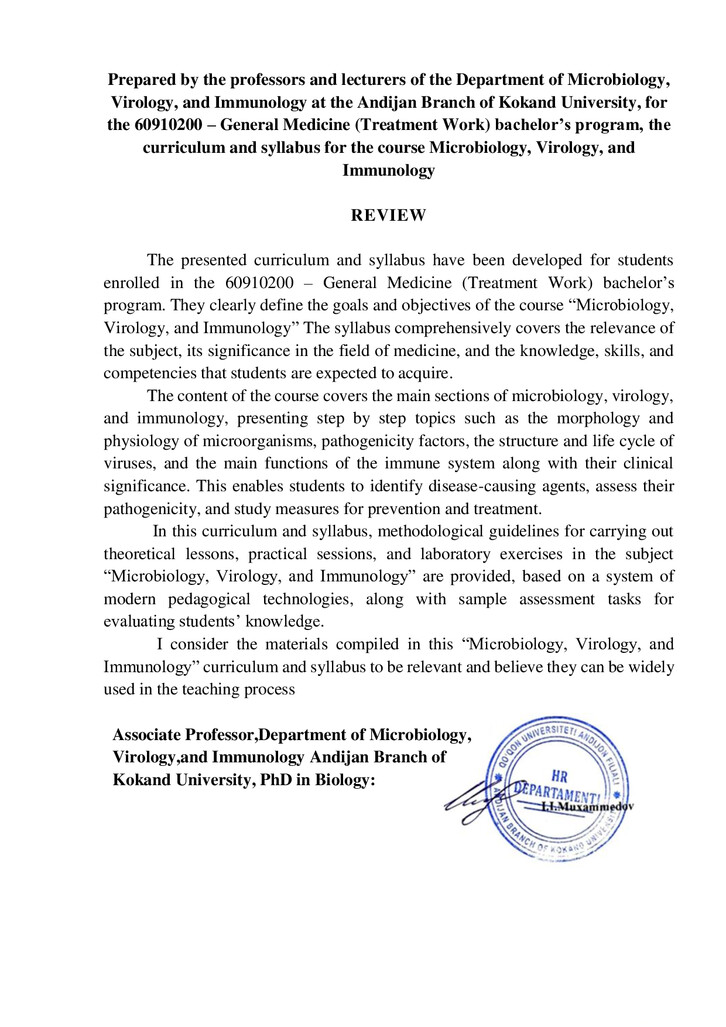
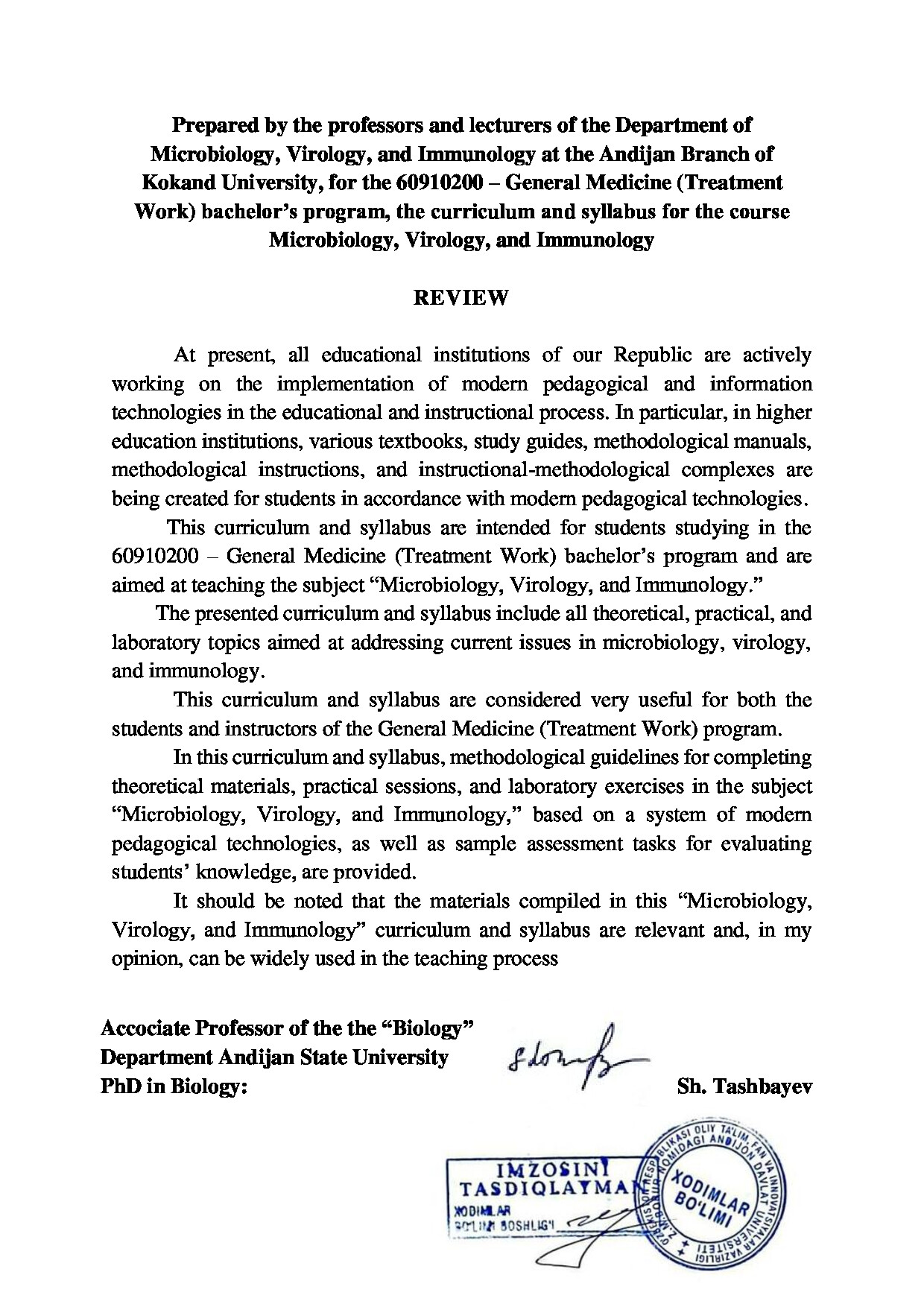
И.Мухаммедов - Associate Professor, Department of Microbiology, Virology and Immunology, PhD in Biological Sciences (b.f.f.d.), --ilmiy darajasini kiriting, masalan, t.f.f.d (PhD) (bor bo'lsa)-- С.Ташбаев - Associate Professor, Department of Biology, Andijan State University, PhD in Biological Sciences (b.f.f.d.), --ilmiy darajasini kiriting, masalan, t.f.f.d (PhD) (bor bo'lsa)-- Yangi taqrizchi qo'shsh |
| Student Office Hours: | Tuesday–Friday, 15:00–17:00, Room 207 |
Силлабус утвержден № _____ протоколом заседания университетского Совета от ______________ 2025 года.
Силлабус утверждён протоколом заседания кафедры «Mikrobiologiya, virusologiya, immunolgiya» № ______ от _______ 2025 года..
|
(imzo) Г.Холбутаев Head of the Academic Affairs Department |
(imzo) Ф.Турдиев Dean of the faculty |
(imzo) I.Muxammedov Head of Department |
(imzo) Р.Абдумуталибов Преподаватель |
|||
|
(imzo) Ш.Жўрабоев Преподаватель |